 RoadFitter°
Your bike fit.
Numbers instead of guesswork.
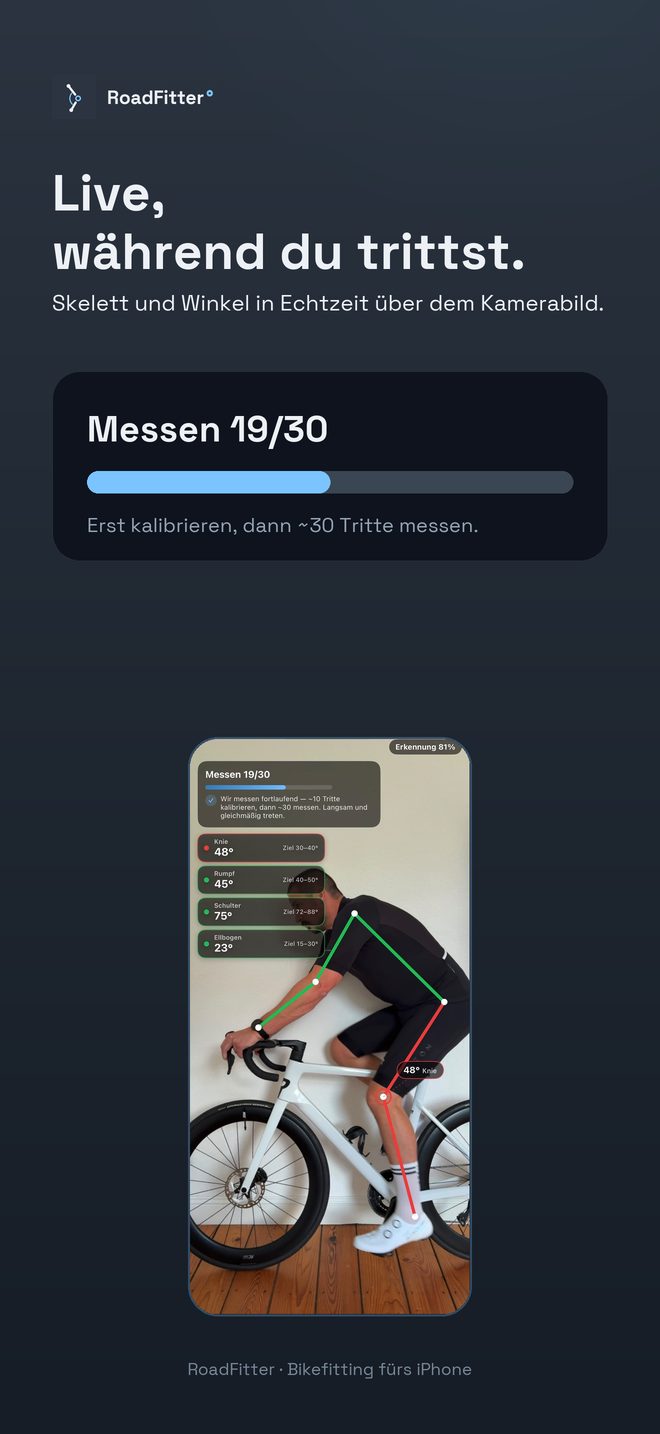
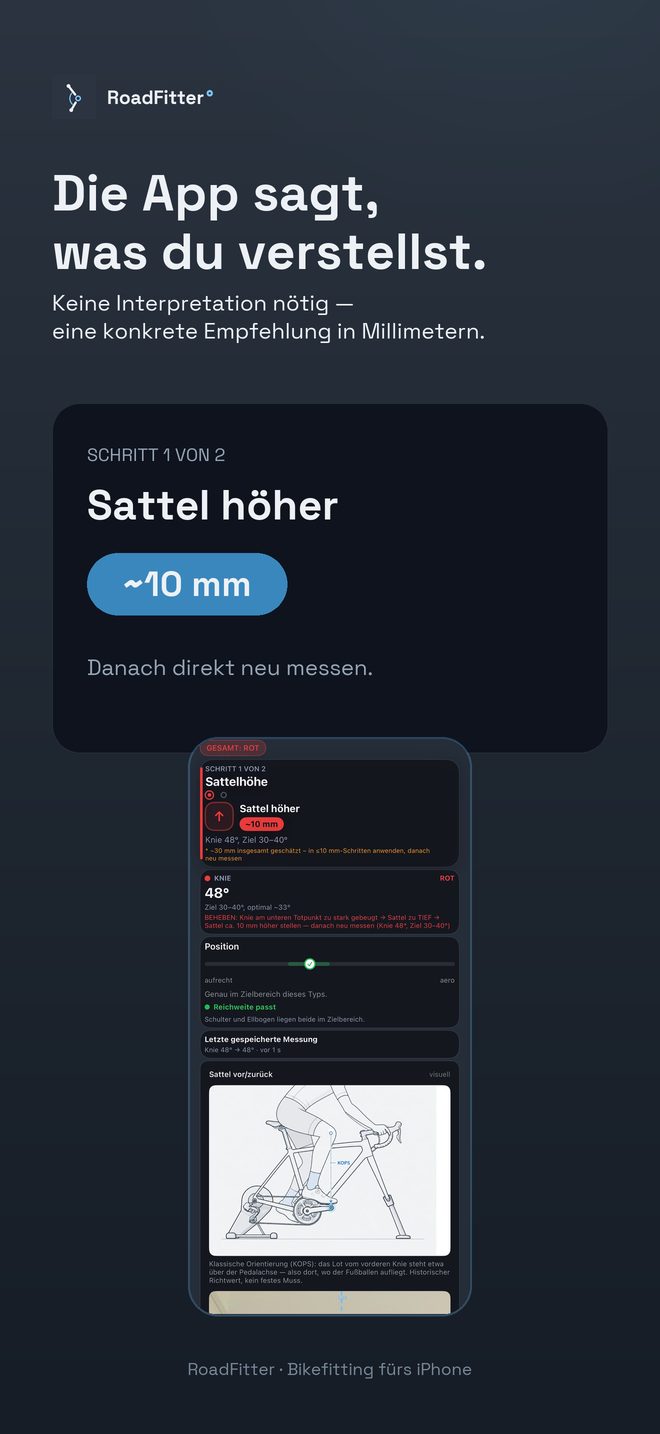
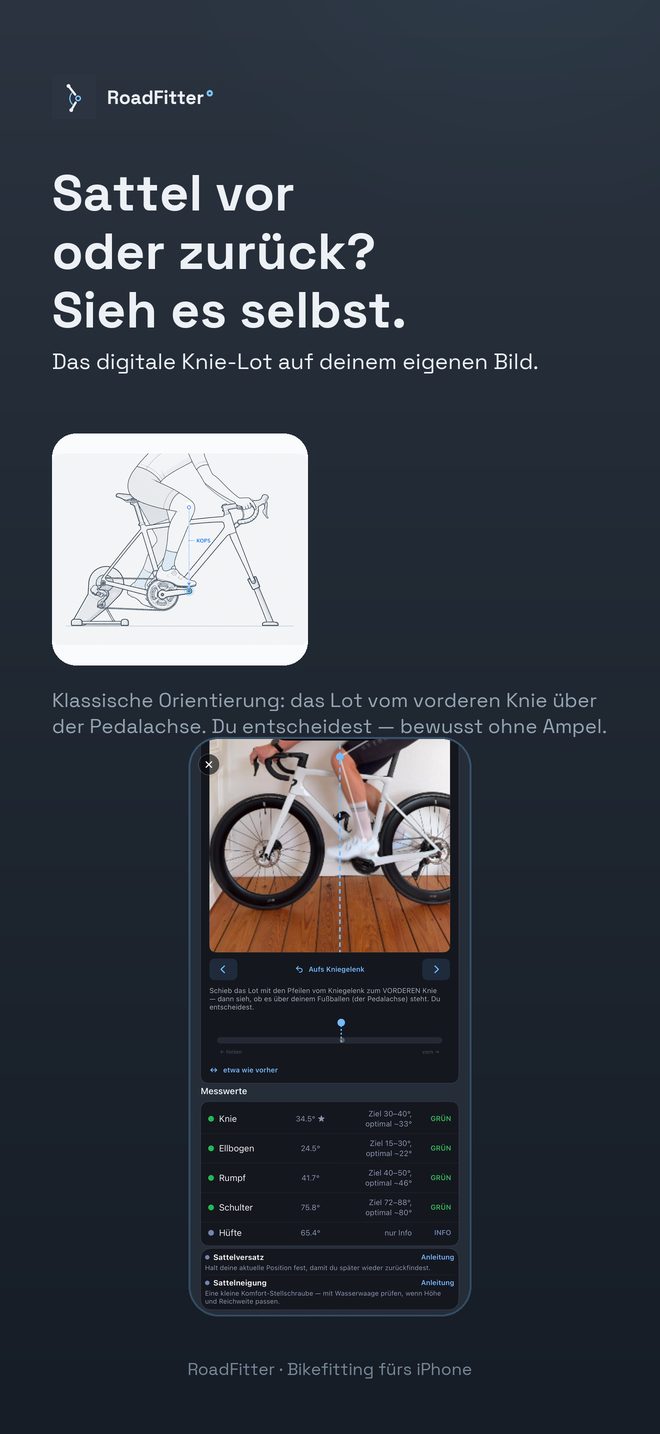
Stand your iPhone or iPad up side-on and pedal. The app finds your joints, measures the angles across the whole pedal sequence — and tells you in millimetres what to change on the saddle.
Download on the App StoreiPhone and iPad · Free download · Pro €39.99 once · no subscription, no account
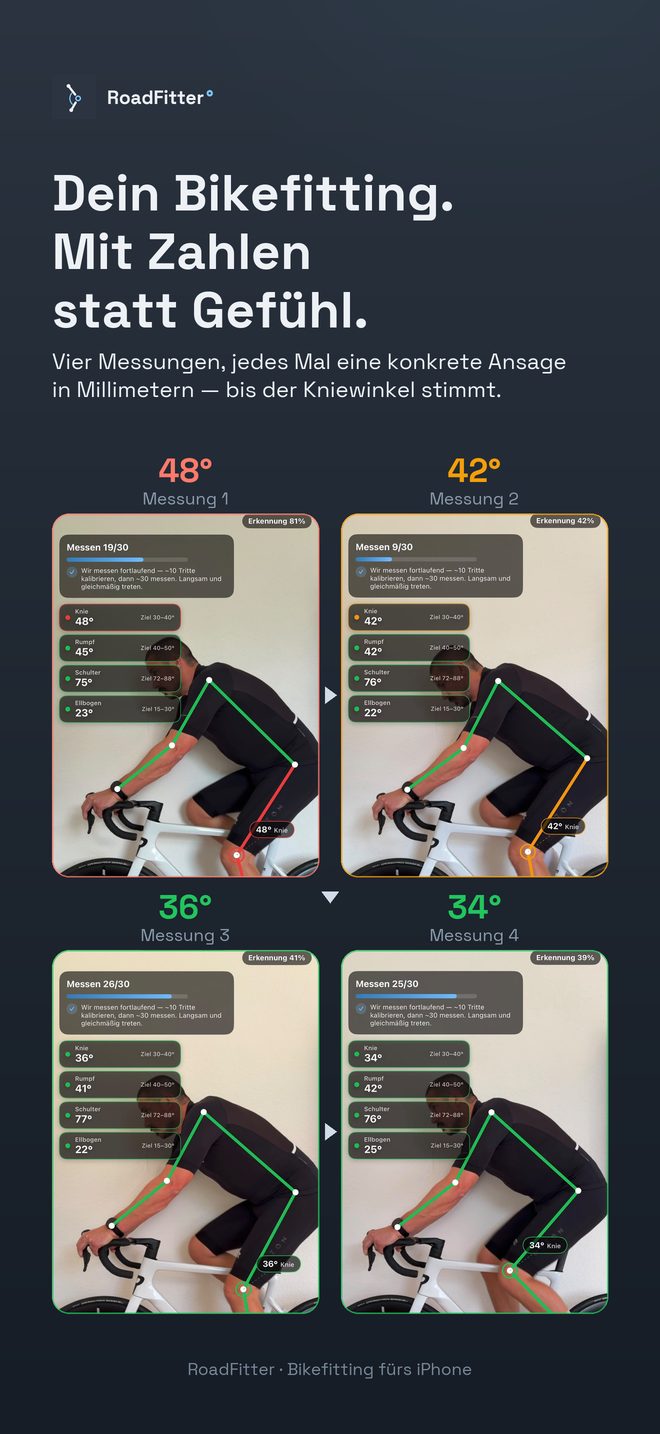
Bike fitting at home, not in a studio
A professional bike fit typically costs €150–450 and eats half a day. With a job and a family there is often no time for that — and plenty of people who are just getting into cycling simply don't know whether they are sitting on the bike correctly at all. RoadFitter does the part that can be measured, on the device you already carry.
- Knee angle at the bottom of the stroke — the one value that is scientifically evidenced and injury-relevant. Torso, shoulder and elbow are guidance based on comfort and riding style. The app says exactly that, too.
- A median across the whole recording, not a snapshot. Outliers are filtered out.
- Live fit with a voice coach, video scan or manual measurement — three routes, the same result.
- Everything stays on your device. No account, no upload, no trackers.
Saddle too high or too low? Your knee will tell you
Most people notice a symptom before they notice a number. Typical for a saddle that is too high: rocking hips, over-extended legs, pain behind the knee or in the Achilles, a feeling of reaching down for the pedal. Typical for a saddle that is too low: pressure or pain at the front of the kneecap, heavy quads, never quite getting power into the pedal.
Both are hints, not diagnoses — the same complaints can come from cleat position, saddle shape or simply too much volume too soon. What can be measured is the angle it all hangs on: the knee angle at the bottom of the stroke. Outside 30–40° and saddle height is the first suspect — which the app checks in two minutes.
- Knee angle for cycling — which values apply, where they come from, and which of them are actually evidenced
- Measuring saddle height instead of calculating it — why the familiar inseam formulas are only a starting point
No subscription. Buy once, done.
Almost every bike fitting app rents itself out: annual subscriptions, tiered plans, or access that expires after two weeks. That fits badly with what a bike fit actually is — a project that finishes, and gets reopened years later when a new bike arrives.
RoadFitter costs €39.99 once. No subscription, no tiers, no follow-up costs, no account. For comparison, a studio bike fit typically runs €150–450 in Germany (prices by country) and needs an appointment. And you can measure again as often as you like — after every adjustment, for every bike.
Which bike?
You pick the bike type, and the target ranges for knee, hip, torso, shoulder and elbow move with it. On a time-trial bike a flat torso is the goal — on a city bike the same posture would be a mistake.
- Road — classic, comfort-oriented or aero
- Gravel — longer distances, a little more upright than on a road bike
- Time trial and triathlon — aerobars, pelvis rotated well forward
- Indoor and spin — upright torso on a studio bike
- City, step-through and kids' bikes — upright, visibility over aerodynamics
Whether you call it bike fitting, bike fit or bikefitting — it means the same thing: adapting the bike to the body instead of the body to the bike.
Honest, not loud
RoadFitter does not replace a good bike fitter. A camera from the side fundamentally cannot see certain things — lateral knee tracking, for instance, or cleat position. What the app can do, it tells you; what it cannot do, it tells you as well. Persistent pain belongs with a qualified professional, not with an app. Whether RoadFitter is the best bike fitting app is your call — we'd rather tell you honestly what a camera can measure and what it can't.
Frequently asked
How much does a bike fit cost?
A professional studio fit typically costs €150–450 in Germany, with different ranges in the UK and US — see bike fit costs by country. RoadFitter measures the part that can be measured — knee angle, saddle height, riding position — at home, for a one-time €39.99 with no subscription. For persistent pain, a professional fitter is still the right call.
Can you do a bike fit yourself?
The measurable part, yes. Saddle height, knee angle and riding position can be determined from a side-on recording — that is exactly what the app does. What needs hands and eyes, such as cleat position or lateral knee tracking, stays with a professional.
How do I find the right saddle height?
Through the knee angle at the bottom of the pedal stroke. Too large and you are sitting too low; too small and you are too high. RoadFitter measures that angle across the whole pedal sequence and converts it straight into millimetres of saddle adjustment.
What knee angle is correct on a road bike?
At the bottom of the pedal stroke the usual target range is 30–40°. The app additionally marks 33° as a target inside that corridor — that is our own choice, not a study value: the literature gives ranges, not point values. It shifts somewhat depending on bike type. More on the knee angle page.
Does the app need internet? Are my videos uploaded?
No and no. Pose detection runs on the iPhone and so does the entire analysis. There is no account, no upload and no trackers.
Does this work for gravel, triathlon or city bikes?
Yes. You pick the bike type and the target ranges for knee, torso, shoulder and elbow adjust to it.